
Growth
Ten placements a month across several pages.
$6,000/month
- Minimum 10 SEO backlinks per month
- Campaigns across multiple priority pages
- Pitching across US and international titles
- Monthly campaign review
Finance and fintech
Finance backlinks are links to banks, lenders, advisors and fintech companies from news and money publications. We earn them with expert comment, quick reactions to rate news and data stories, kept to general education with no advice and no promises about returns.
Updated

Client coverage in



Plans and pricing
Two plans, both month to month. The price you see is the price you pay.
Ten placements a month across several pages.
Twenty placements a month for multi-market teams.
Pay by card or crypto at checkout. Not sure which plan fits? Book a call and we'll tell you. Agencies can resell the same work through white-label link building.
How it works
You send the site and your compliance rules. We plan, write, pitch and report inside them.
We agree what's off limits at the start: no advice and no promises about returns.
A named person from your team, or data stories if nobody wants to be quoted.
Rate news, money data and expert views, sent to business and personal finance journalists.
Each link with its web address, DA and traffic, kept for your records.
Proof
Real articles from data stories we ran for ourselves and for clients, built from public figures and pitched to news desks. Money stories use the same method: public data, a clear ranking and a headline a journalist can check.
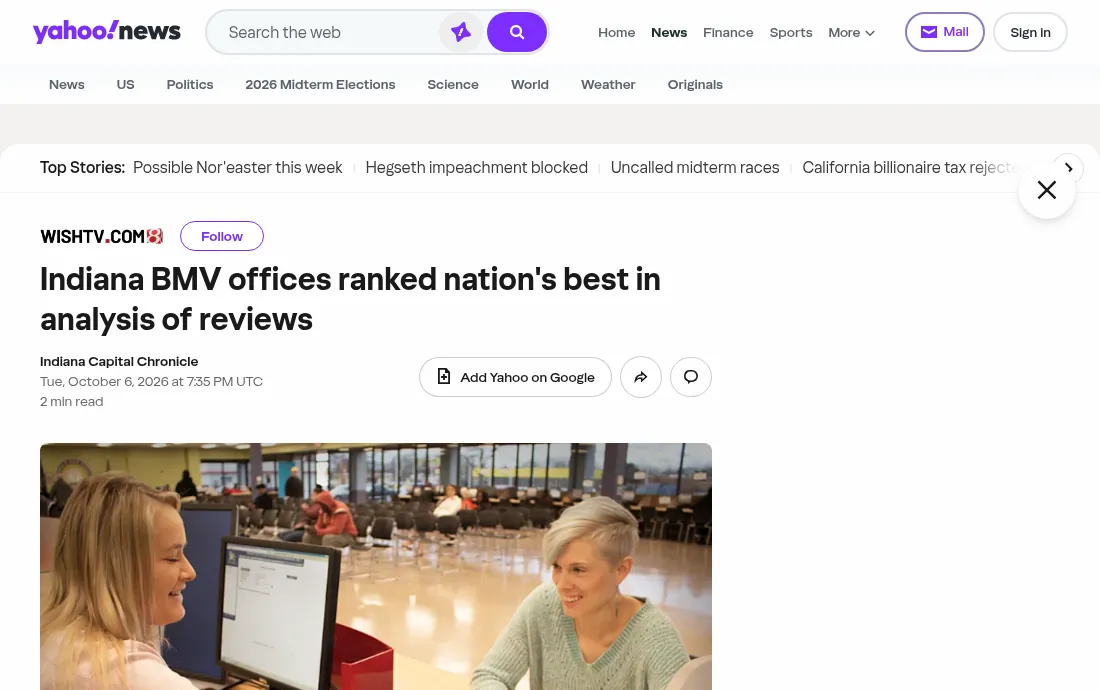
"Indiana BMV offices ranked nation's best in analysis of reviews." Our own data study, October 2026.
It felt closer to digital PR than link buying. Fewer links, better environments, and no pressure to accept placements that did not make sense.
Google holds money content to a higher standard than most topics. Its guidelines call it Your Money or Your Life, and pages about it are judged harder on trust. A link profile full of cheap guest posts is a risk here. The links that help look like evidence of expertise: coverage in news and business publications, earned because a journalist wanted the source.
We build finance backlinks in ways that suit both Google and your compliance team: expert commentary from named, qualified people, quick reaction to rate and market news, and data-led studies that publish their method.
Google's guidelines for its search quality raters ask for more trust on pages that could affect someone's money. Raters are told to look at what independent sources say about a site, not just what the site says about itself. Coverage in respected publications is one of the clearest outside signals of that trust.
The flip side matters just as much. A site held to a higher bar has more to lose from links that look bought. Cleaning up a bad link profile and starting again costs more than building it properly the first time.
Personal finance and business journalists get pitched all day, and they compete with their own in-house experts. A pitch has to give them something they can't write themselves.
| Pitch | Do editors run it? | Why |
|---|---|---|
| Comment on a rate decision from a named, qualified person | Often | It helps them explain the news quickly. |
| Money data with a clear method, such as costs by state | Often | New figures they can't get elsewhere. |
| Myth-busting from a qualified expert | Sometimes | Useful when it ties to something in the news. |
| A product launch or a new rate offer | Rarely | It reads as an ad. |
| Quotes from an unnamed "expert" | No | Readers can't check who said it. |
| Anything that promises returns | No | Editors won't print it, and it can break financial marketing rules. |
Banks, lenders, advisors and fintech companies appear in the press every day. They do it with clear ground rules, and so do we:
If you don't have a spokesperson, data studies and public records requests can carry the campaign. Every placement goes in your report with its web address, DA and traffic, so your compliance team has a full record.
The angles that keep earning coverage:
Money coverage follows a calendar, and journalists plan it ahead. These are the moments worth preparing for:
| Money moment | When coverage runs | Have stories ready |
|---|---|---|
| New Year money goals | Late December and January | November |
| Tax season | February to mid-April | December to January |
| Fed rate decisions | Eight scheduled meetings a year | Your view agreed before each meeting |
| Back-to-school costs | August to early September | June to early July |
| Holiday spending and debt | November to January | September to October |
In finance, coverage does more than pass on a link. Each time your expert is quoted, it adds to a public record of what your people know. Editors notice who gives them usable comment and come back to the same sources.
Not every article links, even when it quotes you. When a publication names your firm without a link, we ask for one while the article is fresh. Our page on digital PR backlinks explains why both matter.
Finance and fintech companies use the same two plans: Growth at $6,000 a month for at least 10 links, and Scale at $9,900 a month for at least 20. Both run month to month. Our backlink packages page shows how to work out how many links a page needs.
Links start going live in the first month. Rankings take longer, and the most competitive money searches, such as credit cards or mortgages, take longest, because the leaders have years of links. Nobody can promise positions, and we don't.
Commitments
Questions
Something we haven't covered? Book a call, or email info@seobacklinks.com and we usually reply within one business day.
Finance backlinks are links to a bank, lender, advisor or fintech site from other websites, which Google counts when it ranks pages. The ones that help most come from news and money publications that chose to cite you.
By giving journalists something they can use: comment on rate and policy news, data on how people pay, save or borrow, and a named expert who explains it plainly. Product news rarely earns links on its own.
Because editors and Google both apply a higher bar to money content. Editors want named, qualified sources and checkable data, and Google's guidelines ask for more trust on pages that could affect someone's money.
Yes, with ground rules. Comment stays educational, nothing promises returns, and off-limits topics are agreed at the start. If your compliance team wants to review quotes, we build that time into the schedule.
Yes. Journalists often quote advisors on general money questions, such as saving for college or what a rate change means. Comments stay general, never advice to a reader, and should follow your firm's own compliance rules.
Many guest post sellers charge extra for finance or turn it down, because their sites don't want the risk. We take on finance and fintech sites, and earn their links through news coverage, inside the compliance rules you set.
Rarely, and never as the pitch. Finance editors reject promotion. Coverage comes from comment, data and analysis with your firm credited as the source, and the selling happens on your own site.
Links start going live in the first month, and your plan sets the monthly minimum. Rankings take longer, often several months, and longest for searches like credit cards or mortgages. Nobody can promise them.
Our plans cost $6,000 a month for at least 10 links, or $9,900 a month for at least 20. The stories, writing, pitching and reporting are included.
Not for rankings. Google expects paid links to be marked as paid, and marked links don't help. On a money site, a pattern of bought links is also a bigger risk than on most other sites.
Start here
Send your website and any rules your compliance team works to. We'll suggest the stories and comment we'd start with, and tell you which plan fits.